Rewrite ( without annotation)
REWRITE on Impact of Technology on Education
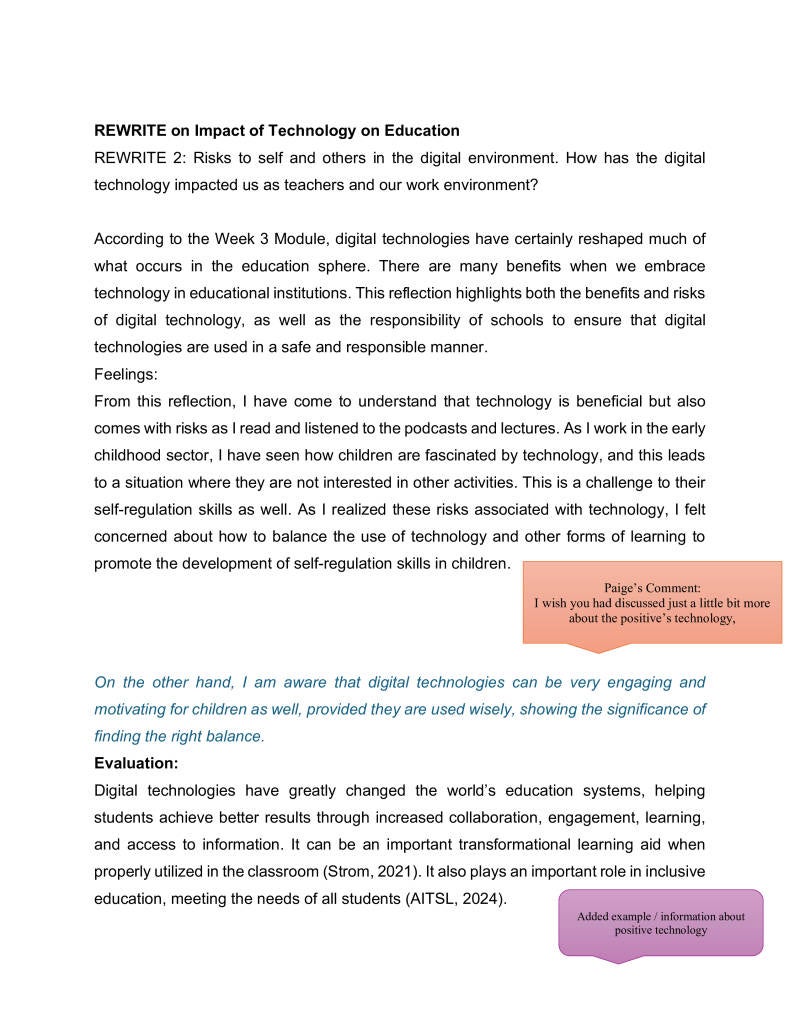
According to the Week 3 Module, digital technologies have certainly reshaped much of what occurs in the education sphere. There are many benefits when we embrace technology in educational institutions. This reflection highlights both the benefits and risks of digital technology, as well as the responsibility of schools to ensure that digital technologies are used in a safe and responsible manner.
From this reflection, I have come to understand that technology is beneficial but also comes with risks as I read and listened to the podcasts and lectures. As I work in the early childhood sector, I have seen how children are fascinated by technology, and this leads to a situation where they are not interested in other activities. This is a challenge to their self-regulation skills as well. As I realized these risks associated with technology, I felt concerned about how to balance the use of technology and other forms of learning to promote the development of self-regulation skills in children.
On the other hand, I am aware that digital technologies can be very engaging and motivating for children as well, provided they are used wisely, showing the significance of finding the right balance.
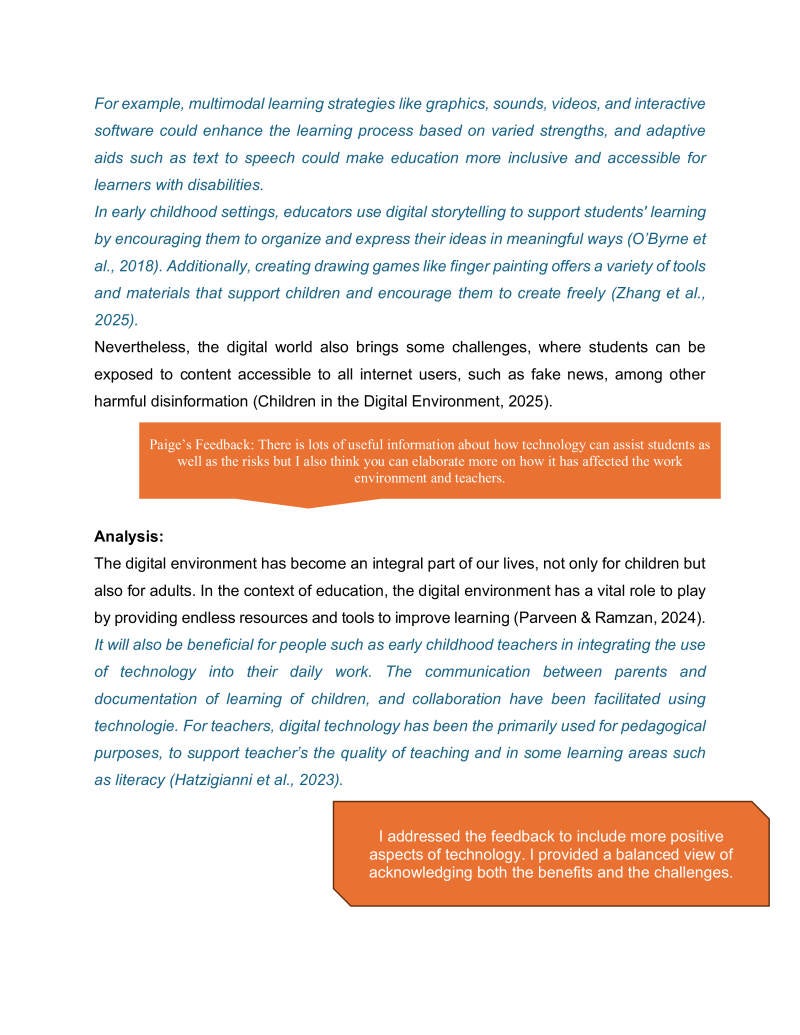
Digital technologies have greatly changed the world’s education systems, helping students achieve better results through increased collaboration, engagement, learning, and access to information. It can be an important transformational learning aid when properly utilized in the classroom (Strom, 2021). It also plays an important role in inclusive education, meeting the needs of all students (AITSL, 2024). For example, multimodal learning strategies like graphics, sounds, videos, and interactive software could enhance the learning process based on varied strengths, and adaptive aids such as text to speech could make education more inclusive and accessible for learners with disabilities.
In early childhood settings, educators use digital storytelling to support students' learning by encouraging them to organize and express their ideas in meaningful ways (O’Byrne et al., 2018). Additionally, creating drawing games like finger painting offers a variety of tools and materials that support children and encourage them to create freely (Zhang et al., 2025).
Nevertheless, the digital world also brings some challenges, where students can be exposed to content accessible to all internet users, such as fake news, among other harmful disinformation (Children in the Digital Environment, 2025).
The digital environment has become an integral part of our lives, not only for children but also for adults. In the context of education, the digital environment has a vital role to play by providing endless resources and tools to improve learning (Parveen & Ramzan, 2024). It will also be beneficial for people such as early childhood teachers in integrating the use of technology into their daily work. The communication between parents and documentation of learning of children, and collaboration have been facilitated using technologie. For teachers, digital technology has been the primarily used for pedagogical purposes, to support teacher’s the quality of teaching and in some learning areas such as literacy (Hatzigianni et al., 2023).
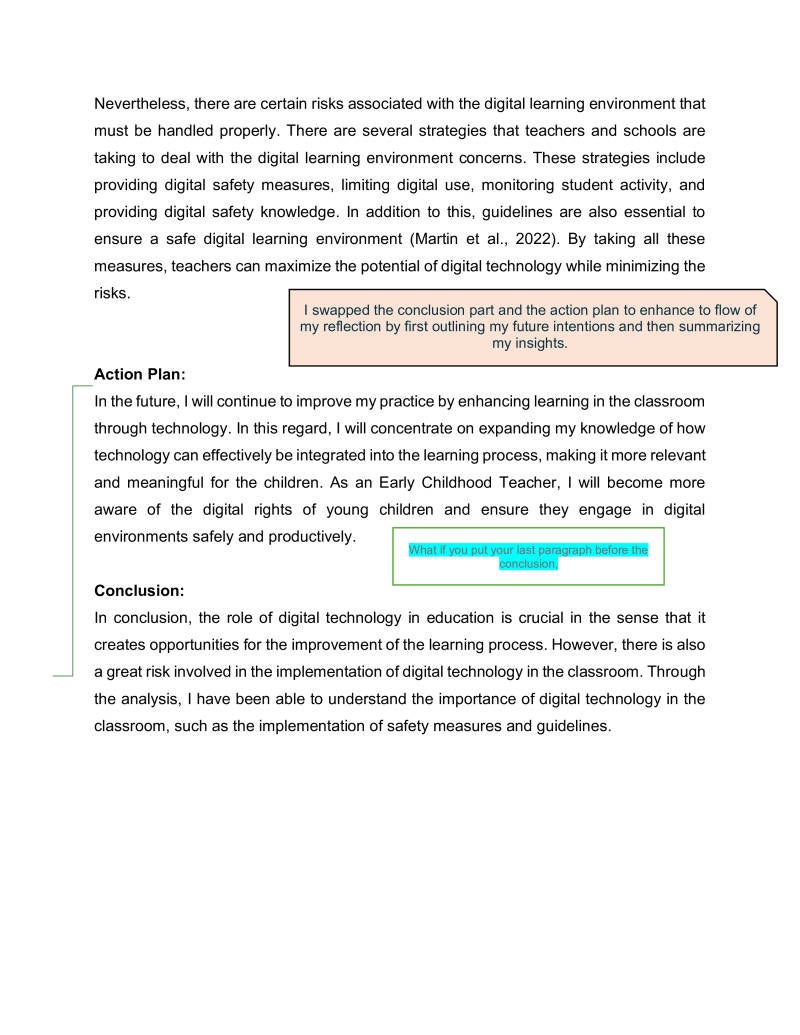
Nevertheless, there are certain risks associated with the digital learning environment that must be handled properly. There are several strategies that teachers and schools are taking to deal with the digital learning environment concerns. These strategies include providing digital safety measures, limiting digital use, monitoring student activity, and providing digital safety knowledge. In addition to this, guidelines are also essential to ensure a safe digital learning environment (Martin et al., 2022). By taking all these measures, teachers can maximize the potential of digital technology while minimizing the risks.
In the future, I will continue to improve my practice by enhancing learning in the classroom through technology. In this regard, I will concentrate on expanding my knowledge of how technology can effectively be integrated into the learning process, making it more relevant and meaningful for the children. As an Early Childhood Teacher, I will become more aware of the digital rights of young children and ensure they engage in digital environments safely and productively.
In conclusion, the role of digital technology in education is crucial in the sense that it creates opportunities for the improvement of the learning process. However, there is also a great risk involved in the implementation of digital technology in the classroom. Through the analysis, I have been able to understand the importance of digital technology in the classroom, such as the implementation of safety measures and guidelines.
Reference:
AITSL. (2024, March). Evaluating the evidence for educational technology - Part 2 - enabling learning. AITSL. https://www.aitsl.edu.au/research/spotlights/evaluating-the-evidence-for-educational-technology-part-2-enabling-learning
CHILDREN IN THE DIGITAL ENVIRONMENT REVISED TYPOLOGY OF RISKS OECD DIGITAL ECONOMY PAPERS. (n.d.). https://www.oecd.org/content/dam/oecd/en/publications/reports/2021/01/children-in-the-digital-environment_9d454872/9b8f222e-en.pdf
Hatzigianni, M., Stephenson, T., Harrison, L. J., Waniganayake, M., Li, P., Barblett, L., Hadley, F., Andrews, R., Davis, B., & Irvine, S. (2023). The role of digital technologies in supporting quality improvement in Australian early childhood education and care settings. International Journal of Child Care and Education Policy, 17(1). https://doi.org/10.1186/s40723-023-00107-6
Parveen, S., & Ramzan, S. I. (2024). The Role of Digital Technologies in Education: Benefits and Challenges. International Research Journal on Advanced Engineering and Management (IRJAEM), 2(06), 2029–2037. https://doi.org/10.47392/IRJAEM.2024.0299
Strom, A. (2021). The Negative Effects of Technology for Students and Educators. https://nwcommons.nwciowa.edu/cgi/viewcontent.cgi?article=1322&context=education_masters
O’Byrne, W. I., Houser, K., Stone, R., & White, M. (2018). Digital Storytelling in Early Childhood: Student Illustrations Shaping Social Interactions. Frontiers in Psychology, 9. https://doi.org/10.3389/fpsyg.2018.01800
Zhang, W., Sun, S., Gao, W., & Chen, P. (2025). Impact of digital games on early creative expression in children: longitudinal study based on experimental intervention. BMC Psychology, 13(1). https://doi.org/10.1186/s40359-025-03619-7
Create Your Own Website With Webador