Rewrite ( without the annotations)
REFLECTION 1
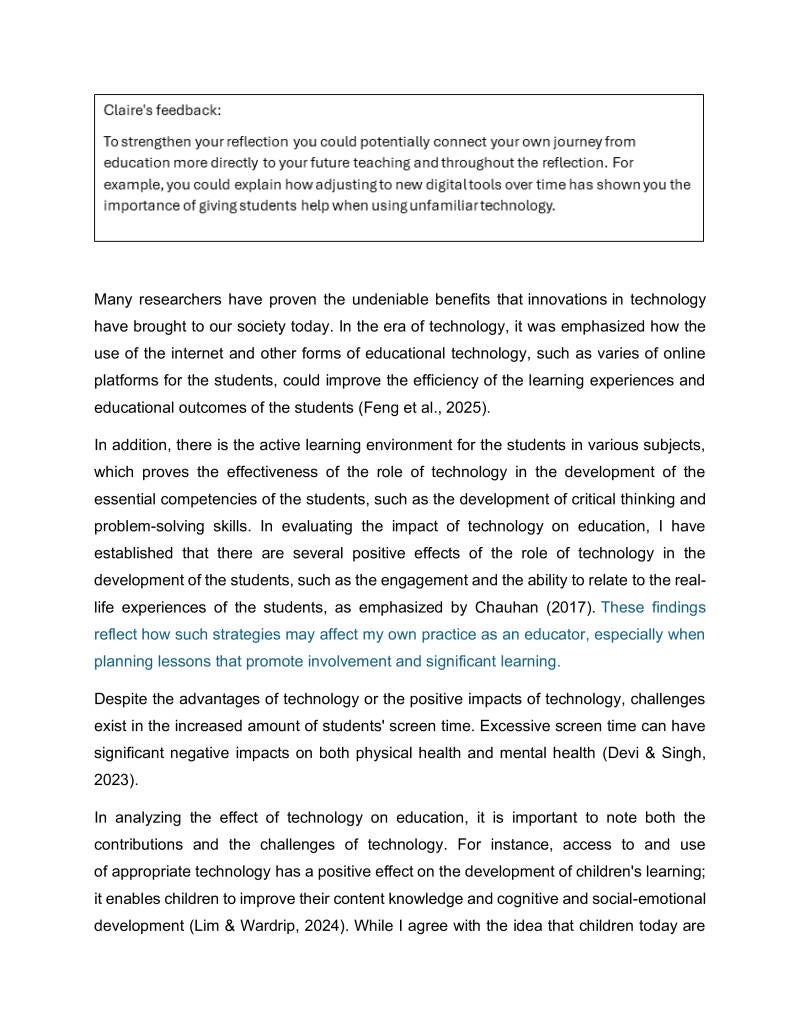
In this reflection/blog entry, I will utilize Gibbs' Reflective Cycle (1988) to reflect on my understanding of the "Impact of Technology on Education." Technology is increasingly becoming an integral component of education, significantly enhancing educational experience and my own experience as a learner have strongly influenced how I view its role in my future teaching practice. Initially, my experience in technology in education was centered on its significance and convenience. During my time in college, my exposure to educational technology in education was limited because it was still in its early stages of development. This was particularly clear during my overseas university where technology was not widely used as a teaching tool. As a student, this often meant that learning was less active and more knowledge-driven, which eventually helped me understand the importance of interactive digital technology. However, in my final year of university education, I was able to witness the incorporation of technology in our educational environment. We were able to use multimedia presentations as well as other technology in our learning process, which was quite effective in enhancing our learning process. Adapting to this modern technology enabled me to understand the significance of teachers in guiding students during the process of adaptation to modern technology.
Many researchers have proven the undeniable benefits that innovations in technology have brought to our society today. In the era of technology, it was emphasized how the use of the internet and other forms of educational technology, such as varies of online platforms for the students, could improve the efficiency of the learning experiences and educational outcomes of the students (Feng et al., 2025).
In addition, there is the active learning environment for the students in various subjects, which proves the effectiveness of the role of technology in the development of the essential competencies of the students, such as the development of critical thinking and problem-solving skills. In evaluating the impact of technology on education, I have established that there are several positive effects of the role of technology in the development of the students, such as the engagement and the ability to relate to the real-life experiences of the students, as emphasized by Chauhan (2017). These findings reflect how such strategies may affect my own practice as an educator, especially when planning lessons that promote involvement and significant learning.
Despite the advantages of technology or the positive impacts of technology, challenges exist in the increased amount of students' screen time. Excessive screen time can have significant negative impacts on both physical health and mental health (Devi & Singh, 2023).
In analyzing the effect of technology on education, it is important to note both the contributions and the challenges of technology. For instance, access to and use of appropriate technology has a positive effect on the development of children's learning; it enables children to improve their content knowledge and cognitive and social-emotional development (Lim & Wardrip, 2024). While I agree with the idea that children today are "digital natives," the over-reliance on screens has also raised important public health concerns that could impact cognitive, linguistic, and social-emotional development. It is the role of parents and educators to research strategies to effectively manage children's use of screens (Muppalla et al., 2023). This reflection is important for my personal future because it demonstrates that the use of technology should be used wisely rather than unnecessarily.
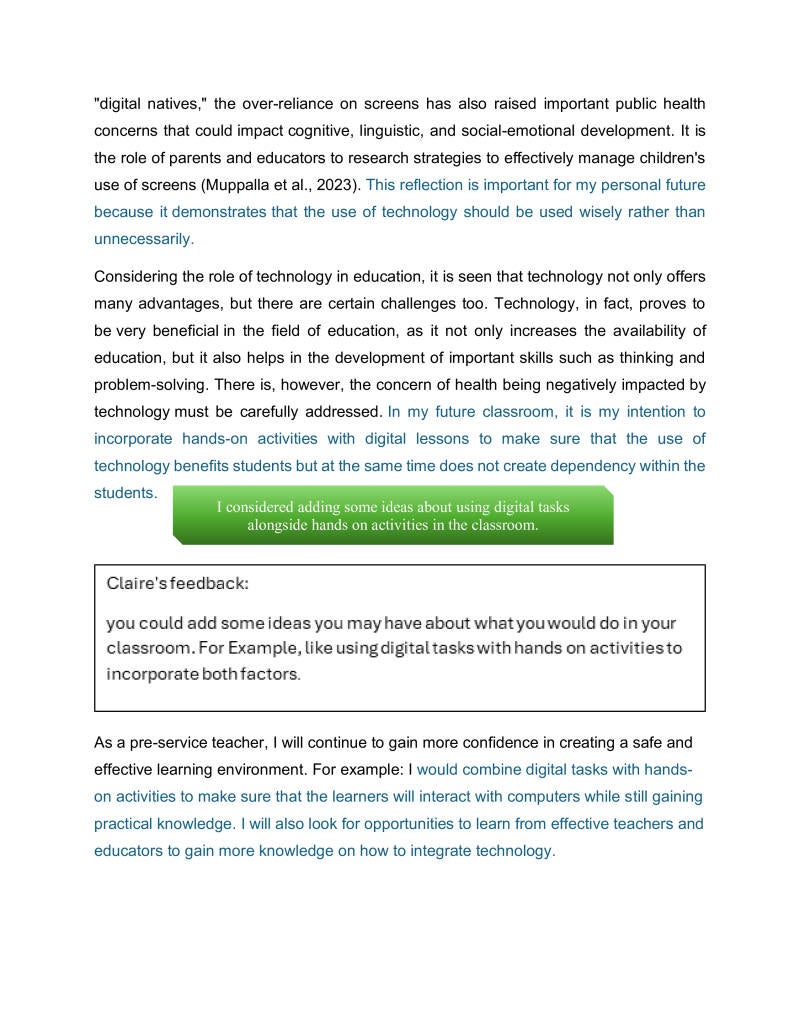
Considering the role of technology in education, it is seen that technology not only offers many advantages, but there are certain challenges too. Technology, in fact, proves to be very beneficial in the field of education, as it not only increases the availability of education, but it also helps in the development of important skills such as thinking and problem-solving. There is, however, the concern of health being negatively impacted by technology must be carefully addressed. In my future classroom, it is my intention to incorporate hands-on activities with digital lessons to make sure that the use of technology benefits students but at the same time does not create dependency within the students.
As a pre-service teacher, I will continue to gain more confidence in creating a safe and effective learning environment. For example: I would combine digital tasks with hands-on activities to make sure that the learners will interact with computers while still gaining practical knowledge. I will also look for opportunities to learn from effective teachers and educators to gain more knowledge on how to integrate technology.
References:
Chauhan, S. (2017). A meta-analysis of the Impact of Technology on Learning Effectiveness of Elementary Students. Computers & Education, 105(1), 14–30. https://doi.org/10.1016/j.compedu.2016.11.005
Devi, K. A., & Singh, S. D. (2023). The Hazards of Excessive Screen time: Impacts on Physical health, Mental health, and Overall well-being. Journal of Education and Health Promotion, 12(1). https://doi.org/10.4103/jehp.jehp_447_23
Feng, J., Yu, B., Tan, W. H., Dai, Z., & Li, Z. (2025). Key factors influencing educational technology adoption in higher education: A systematic review. PLOS Digital Health, 4(4), e0000764. https://doi.org/10.1371/journal.pdig.0000764
Lim, J., & Wardrip, P. (2024). Technology Integration as a Spectrum: integrating technology in early childhood classrooms. Teachers and Teaching, 1–19. https://doi.org/10.1080/13540602.2024.2420137
Muppalla, S. K., Vuppalapati, S., Pulliahgaru, A. R., & Sreenivasulu, H. (2023, June 18). Effects of Excessive Screen Time on Child Development: an Updated Review and Strategies for Management. National Library of Medicine; Cureus. https://pmc.ncbi.nlm.nih.gov/articles/PMC10353947/
Create Your Own Website With Webador